A reader can spend hours reading your book, but you may have only seconds to convince them to pick it up. That first impression often begins with the cover. In fact, a Random House/Zogby poll reported by Publishers Weekly found that 52% of respondents said cover art had influenced their book purchases. That does not mean a beautiful cover guarantees sales.
So, how much does book cover design and illustration actually cost? The cost depends on multiple factors. If you are preparing to publish a book, understanding the process can help you set a realistic budget without sacrificing the visual quality of your book.
Key Takeaways
- Custom illustrations generally require more creative development than simple typographic or image-based covers.
- Print and eBook covers have different technical requirements, which can affect the overall project.
- A professional cover should be visually appealing, pique a reader’s interest, and fulfill production requirements.
The Cover Is the Key to Your Book’s Identity
Imagine two books with identical titles. One has elegant typography, restrained colors, and an emotionally appropriate image. The other uses several fonts, unrelated imagery, and a crowded layout. Even before reading the descriptions, readers are likely to form different expectations about the books.
That is why professional cover design considers:
- Typography
- Color
- Composition
- Imagery
- Illustration
- Genre conventions
- Title hierarchy
- Author branding
- Target audience
The goal is to ensure that the cover captures the reader’s attention at first glance, prompting them to wonder what the book is about.
What Is Included in Book Cover Design?
When authors hear “cover design,” they sometimes imagine a designer simply placing an image behind the title. Professional design involves much more. The process involves concept development, visual references, typography, image selection, layout, revisions, and final production files.
Concept Development
The first step is determining what the cover should communicate. For a thriller, that might mean tension and mystery, while a children’s book may require a completely different visual language. The designer is responsible for translating the book’s central idea into a visual concept. That requires creative judgment rather than simply applying a template.
Typography
Typography can dramatically change how a cover feels. Decorative lettering may work well for certain children’s books or creative projects. But typography must also remain readable, which becomes particularly important when the cover is displayed as a small thumbnail online.
Imagery
Some books work best with photography. Others benefit from stock imagery, abstract compositions, digital artwork, or custom illustrations. The appropriate choice depends on the story and the intended audience.
Illustration
Illustration can be especially valuable across many genres of books. A custom book illustration can create a distinctive visual identity that stock imagery may not provide. However, illustration can also increase the project scope. A single illustrated cover may be relatively straightforward, but a detailed scene involving multiple characters, backgrounds, props, and specific visual directions requires considerably more creative work.
How Much Does Book Cover Design Cost?
There is no universal rate for book cover design and illustration. Instead of looking for one fixed number, authors should understand what determines the price.
| Cover Project | Typical Complexity | Factors Affecting Cost |
|---|---|---|
| Basic typographic cover | Low | Typography, layout, simple graphics |
| Premium illustrated cover | Moderate–High | Custom artwork, character development, detail |
| Print + eBook package | Varies | Separate technical specifications and adaptations |
| Full print cover | Moderate–High | Front, spine, back, bleed, barcode area, print setup |
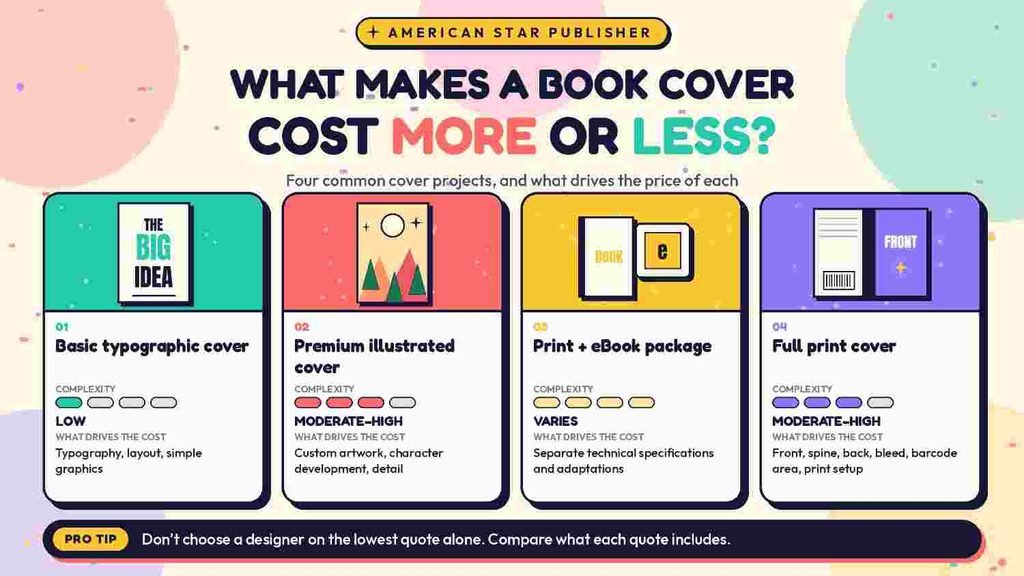
Comparing these project types is useful for understanding why quotes can differ significantly between projects. An author should be cautious about choosing a designer based entirely on the lowest quote.
What Factors Affect the Cost of a Book Cover?
Several variables can influence the final price.
Complexity of the Design
A minimalist cover may require relatively little visual development, while a complex composition involving multiple visual elements requires more planning and refinement.
Custom Illustration
A custom illustration can require sketching, character development, and coloring. For example, illustrating a children’s picture book cover may involve creating recognizable characters and an environment that reflects the story. That is very different from using a licensed photograph with professionally arranged typography.
Number of Revisions
Revisions are an important part of the design process. However, unlimited revisions can significantly expand a project. Before beginning, authors should understand how many revision rounds are included and what happens if additional changes are requested.
Image Licensing
If photographs, illustrations, fonts, or other third-party assets are used, licensing requirements may affect the cost. The U.S. Copyright Office explains that original visual artwork can receive copyright protection and that permission may be required when someone wants to use another person’s protected artwork. Don’t assume that an image found online is automatically free to use.
Print and Digital Requirements
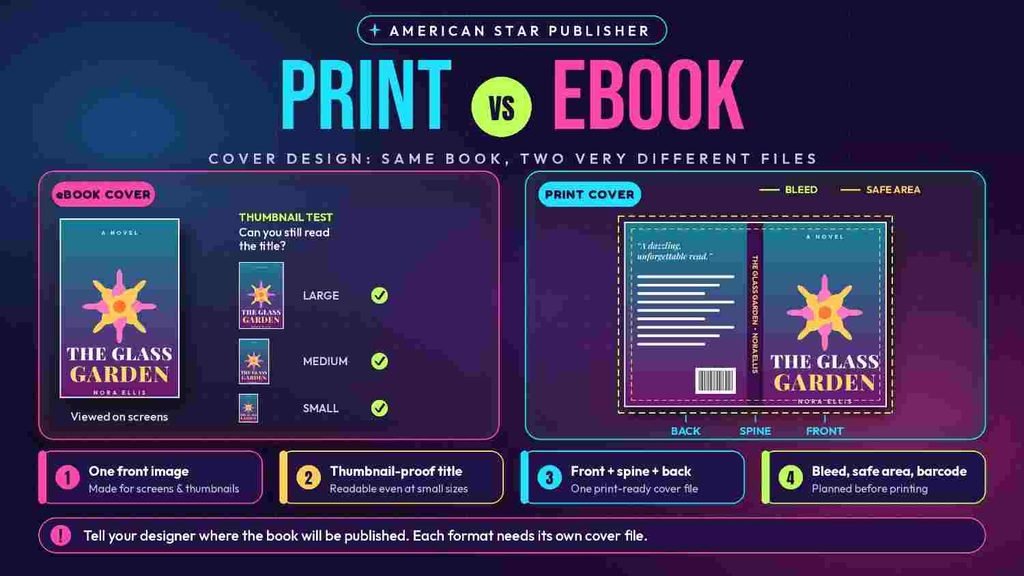
A cover designed for an eBook does not necessarily function as a complete print cover. A print cover may require a front cover, spine, and back cover. Amazon KDP, for example, requires paperback covers to be submitted as a single PDF containing the back cover, spine, and front cover. This is one reason an author may pay more for a complete print and eBook cover design package than for an eBook cover alone.
Book Cover Design for Print vs. eBook
The final destination of your book matters.
eBook Cover Design
An eBook cover is primarily viewed digitally, so the design must remain recognizable at different sizes. A cover that looks impressive at full resolution may become difficult to understand when reduced to a small thumbnail.
Thumbnail Readability Matters
Readers should still be able to identify the title and understand the visual direction of the book without zooming in.
Print Cover Design
Print introduces another layer of technical considerations. A paperback cover generally needs to account for the front cover, back cover, spine, trim size, bleed, safe areas, and barcode placement. Amazon KDP states that its paperback covers require a 0.125-inch or 3.2 mm bleed on the outside edges. That means professional book cover formatting is a part of preparing a file that can actually move successfully into production.
Real-World Scenario: Why One Cover Can Cost More Than Another
Consider two authors.
Author A: Business Book. The author wants a clean cover for a practical business guide. The concept uses strong typography, a simple background, and a limited number of graphic elements. The design does not require custom artwork.
Author B: Children’s Fantasy Book. The author wants a magical forest scene featuring three original characters, a detailed environment, custom lettering, and several rounds of revisions. The second project requires significantly more artistic development.
Both authors need a book cover, but their projects are not equivalent. The amount of creative work behind the final image is what makes the difference.
Bonus Point: Your Cover Must Work as a Thumbnail
Here is a simple test. Open your cover on your computer, then make it very small. Can you still read the title? If it disappears when the cover becomes small, the design may need refinement.
This matters because online readers frequently encounter books as small images rather than full-size physical objects.
Where Do Editing and Writing Fit into the Process?
Cover design should begin with a clear understanding of the book. That makes writing and editing important parts of the overall publishing process. A poorly developed manuscript can make it difficult to identify the book’s strongest themes. For nonfiction, editing can improve structure and readability. For fiction, it can help strengthen character development, pacing, and narrative flow.
If you are not sure which stage your manuscript needs, our guide to the types of book editing explains developmental editing, copy editing, and proofreading.
That is why a complete publishing journey may involve:
Writing → Editing → Design → Publishing → Printing → Audiobook → Marketing
Each stage supports the next.
What About Audiobook Covers?
Authors publishing an audiobook should also consider how the cover will translate into an audio format. The artwork may need to remain recognizable when displayed alongside other audiobook titles, and the title and author name should be clear.
The design should also remain consistent with the print and eBook editions. A coordinated visual identity can help readers recognize the same book across multiple formats.
Professional Book Cover Design at American Star Publisher
At American Star Publisher, book cover design can be part of a broader publishing journey. Authors may need help with more than one isolated task. They may need assistance developing a manuscript, editing the content, creating a professional cover, preparing files for publication and printing, producing an audiobook, and promoting the finished book.
Our services include writing, editing, publishing, printing, audiobook production, marketing, design, and illustration. This allows authors to approach publishing as a connected process rather than managing every stage separately.
Whether your project needs a clean typographic cover, a compelling photographic concept, or a custom illustrated design, the objective should remain the same: a cover that attracts the right readers and represents your book accurately.
Disclaimer
Book cover design and illustration costs vary widely. There is no universal price that applies to every author or publishing project. Actual costs can depend on the designer or publishing provider, project complexity, illustration requirements, licensing, revisions, formats, deadlines, and other specifications.
The technical requirements mentioned in this article are examples based on current Amazon KDP guidance and may change. Always check the requirements of your intended publishing and printing platform before submitting final files.
Conclusion: Is Professional Book Cover Design Worth the Cost?
Your book may contain an unforgettable story. It may offer valuable information. But readers cannot appreciate any of that until they decide to open the book. That is where your cover matters.
The cost of book cover design and illustration should therefore be considered in relation to the creative work, technical requirements, and publishing goals behind the project. The right choice depends on your book, audience, genre, budget, and publishing strategy.
Ultimately, the goal is not simply to create an attractive cover. It is to create a professional visual introduction to your book that communicates its identity, captures attention, and works across the formats where readers will discover it.
Because before a reader falls in love with your words, they may first have to fall for the cover.