Finishing a manuscript is a massive milestone, but getting those last words onto paper is just step one. Converting a first draft into a polished book takes a process that catches many new writers off guard. Editing is a multi-step journey that shapes your ideas and cleans up tiny mistakes so your readers get the absolute best version of your work.
If you have been looking into self-publishing, you have likely run into terms like developmental editing, line editing, copy editing, and proofreading. It is easy to feel confused by all this industry jargon, especially when trying to figure out what your manuscript needs and how to budget for it. The total cost to publish a book varies based on the editorial path you take, so understanding what happens at each stage is essential. Skipping key steps can leave big plot holes in your story, while picking the right combination gives your book a traditional-publisher quality.
We are going to break down the entire editing process below. Let’s walk through the four distinct phases of manuscript editing and help you decide which services will give your draft the professional polish it needs before hitting bookshelves.
Types of Editing
Thinking about professional book editing for self-publishing? Collaborate with our trusted book editing services for authors and let us make your life easier. Our team will take care of the editing process and free up your time and energy so you could focus on other aspects of your life or business. Here are some of the types of professional book editing services we offer:
Developmental Editing
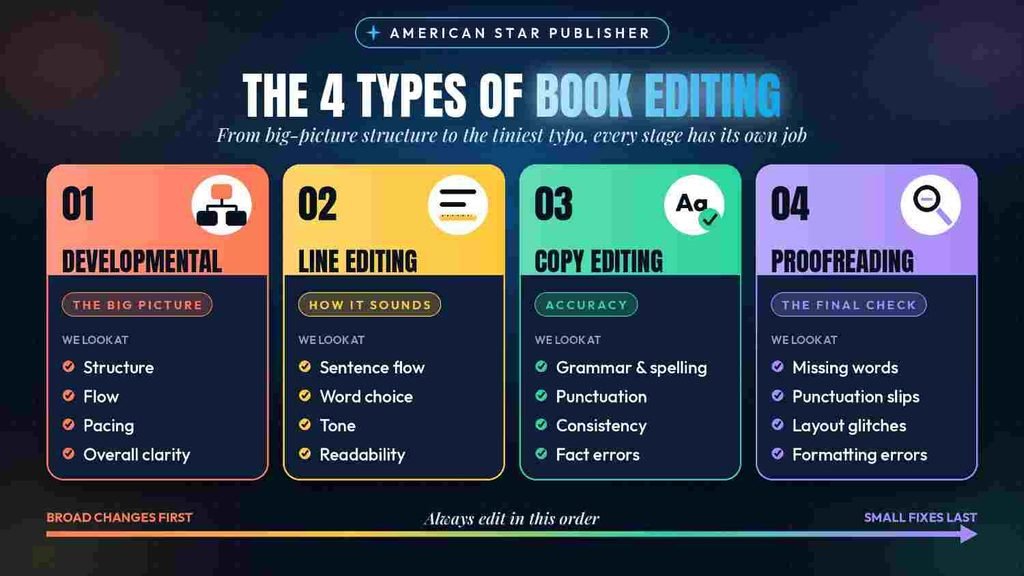
For developmental editing, we look at:
- Structure
- Flow
- Pacing
- Overall clarity
We make sure your story makes sense from start to finish. Developmental editing is the type that helps strengthen plots and chapter organization. If your manuscript feels confusing, it is what shapes your ideas into a well-organized book.
When working on a developmental edit, an editor takes a high-level view of the document. This requires fiction writers to pay great attention to chapter transitions and story arcs. A developmental editor identifies problems and looks for solutions if a character behaves inappropriately in chapter four or if a subplot disappears without explanation halfway through.
Logical organization is a major component of developmental editing for non-fiction writers. Our editor verifies that the content is understandable to your audience and that your primary concepts flow from one notion to the next. They may recommend rearranging whole sections or elaborating on points that require more information.
It’s a creative stage. An editorial criticism provides you with comprehensive feedback by highlighting your strengths and areas for improvement. Developmental editing should always be done before making changes to individual sentences because it entails significant rewrites. Time and effort are lost when line changes are made before major plot gaps are fixed since vast passages of text may need to be rewritten or completely removed.
Line Editing
Line editing improves how your writing sounds. Our author manuscript editing in USA focuses on:
- Sentence flow
- Word choice
- Tone
- Readability.
This stage smoothens:
- Awkward phrasing
- Repetitive language
- Unclear sentences.
Line editing makes your writing more natural; your book is enjoyable to read without changing your message or personality as an author.
But then how is line editing different from developmental editing? The latter focuses on plot, whereas the former works at the sentence and paragraph level. During a line edit, the editor looks for places where your writing tells rather than shows. They spot clunky sentence phrasing and stiff dialogues. They also make sure your tone stays consistent across every chapter. If your text suddenly shifts from a warm, conversational tone to a stiff, textbook vibe, the line editor catches that shift and helps smooth out the transition.
Working with a line editor is one of the quickest ways to improve your writing skills. Rather than rewriting your book for you, a good line editor gives suggestions that keep your distinct creative voice while polishing away awkward phrasing. The final result is a draft that reads effortlessly from start to finish.
Copy Editing
Copy editing brings accuracy and consistency throughout your manuscript. Our book editing services in USA correct grammar, spelling, punctuation, and sentence structure while checking for repeated words, inconsistencies, and factual errors. Copy editing ensures your writing looks professional and polished. It maintains a consistent style and formatting across chapters, so your book is ready for the final stages of publishing.
If line editing is the artistic pass, copy editing is the technical cleanup phase. It centers on mechanical accuracy and consistency across your manuscript. Copy editors rely on established publishing style guides, like the Chicago Manual of Style for trade books, to ensure punctuation and capitalization choice matches industry norms.
One of the most important parts of copy editing is creating a style sheet for your book. This document tracks character names, location details, timeline facts, and unique terminology. If a character’s name is spelled one way on page 20 and a different way on page 140, the copy editor catches the mistake and fixes it. If a non-fiction draft references historical dates incorrectly or switches between spelling conventions, the copy editor ensures consistency throughout the entire text.
Copy editing also checks clarity at a technical level. The editor looks for dangling modifiers, verb tense slips, run-on sentences, and confusing pronoun references. They make sure transitions between paragraphs make logical sense and that technical terms are explained clearly. When your manuscript finishes copy editing, it is clean, accurate, and ready for interior page design.
Proofreading
Proofreading is the final quality check before your book is published. We carefully review the manuscript to catch small mistakes like missing words and punctuation errors. It happens after all major edits are complete. Proofreading ensures your book looks error-free when it reaches readers.
People mix up proofreading and copy editing, but they happen at entirely different points in the publishing process. Copy editing happens in the initial drafts while the prose is still being edited and changed. Proofreading takes place at the very end of the line, after the manuscript has been copyedited and laid out into its final interior format.
A proofreader’s main job is catching the tiny errors that slipped past earlier editing passes or were introduced during layout design. Converting text into print-ready files or ebook layouts can sometimes cause bad line breaks or missing headers. A proofreader reads through the formatted PDF proof or preview file with extreme care.
They look for formatting glitches in drop caps or block quotes. Because proofreading is your last safety net before your book prints or goes live on online stores, it requires attention to detail. Having fresh professional eyes review your final proof means readers can focus on your story instead of distracting typos or layout flaws.
How the Four Stages Work Together in Sequence
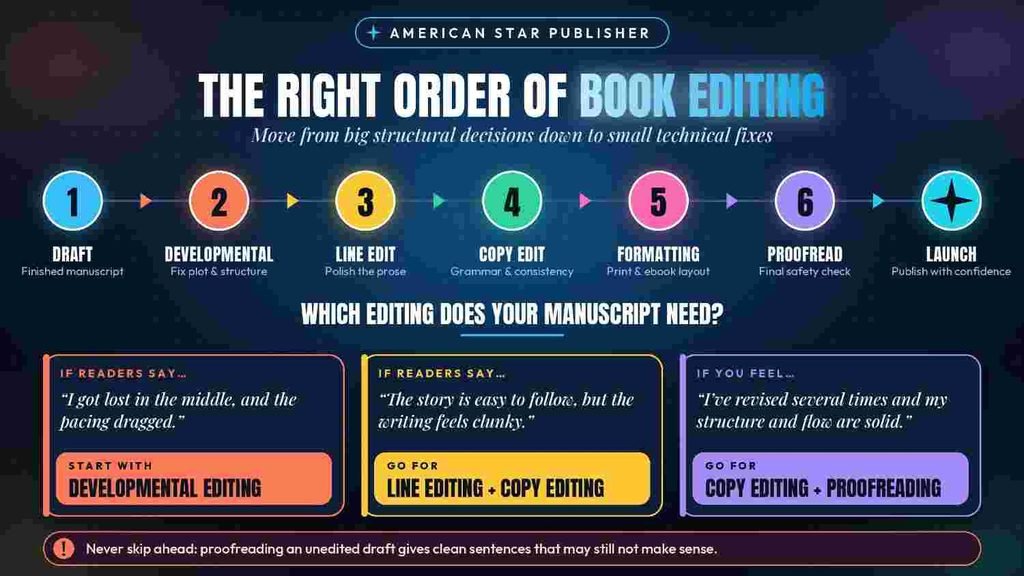
Knowing how these editing passes build on each other saves you time. The editing pipeline works best when moving from broad structural decisions down to small technical fixes.
First comes developmental editing, where you tackle the core foundation of your draft. You address plot gaps, tighten structural pacing, and refine your main message. Once your structure is locked in and no major scenes or chapters are being added or cut, you move to line editing. Here, you focus on sentence quality, making sure your prose sounds natural and engaging.
Next, your manuscript goes through copy editing to enforce correct grammar, style rules, and internal consistency. Once you approve those copy edits, your text moves to interior formatting for print and ebook versions. Finally, proofreading gives you a final safety check on the formatted pages before your book officially launches.
Trying to skip straight to copy editing or proofreading on a draft with major plot problems usually backfires. If you pay for proofreading on an unedited draft, you end up with grammatically clean sentences that might still fail to make sense in the story. Following this natural sequence ensures every dollar you spend on editing gives you maximum value.
Choosing the Right Editing Options for Your Manuscript
Every manuscript lands on an editor’s desk in a different state. Some writers turn in clean first drafts that only need minor sentence polishing and copy editing. Others bring great ideas packaged in disorganized chapters that need structural guidance to reach their potential.
To figure out what your manuscript needs, look for honest feedback. Beta readers, critique groups, or manuscript reviewers can give you an unbiased opinion on whether your story structure holds together. If readers tell you they got confused in the middle or felt the pacing dragged, investing in developmental editing is your best move.
If readers find your story easy to follow but mention that the writing feels clunky or repetitive, combining line editing and copy editing will clean up your sentence flow and fix your grammar. If you have already revised your draft several times and feel solid about your structure and flow, moving straight to copy editing followed by a proofread will get your book launch-ready.
Keep your publishing goals in mind as well. If you are releasing a book to build authority in your industry, secure speaking gigs, or compete with top sellers in your genre, professional editing across every needed stage is essential. Readers form opinions quickly based on writing quality, and a well-edited book builds immediate credibility.
The True Value of Professional Book Editing
It is easy to view editing as just another expense on your self-publishing checklist, but experienced authors see it as a direct investment in their writing career. A well-edited book gets better reader reviews, generates word-of-mouth sales, and helps you build an audience that will buy your next release.
Editing goes far beyond fixing typos; it is a creative partnership that elevates your voice and brings out the best version of your work. Working with professionals who respect your vision turns editing into a rewarding experience that makes you a stronger writer.
Taking a raw first draft and turning it into a published book is a big journey. By picking the editing services that fit your manuscript’s exact needs, you can publish with confidence, knowing your final book stands tall alongside top titles in your genre. When you are ready to give your manuscript the polish and professional care it needs, working with an experienced editorial team makes sure your story reaches its full potential.